Tarn matthias
My primary aim for recording with Tarn Matthias was to gain experience in using the university’s new studio space, The Hive, rather than to produce a single for release. I was providing Tarn with a complete mix and master but was unsure whether he had any plans on a release. I was also using the session to gauge how quickly I worked when engineering, especially for a whole 8-hour day, in order to begin figuring out what my day rate could look like as an engineer.
The plan was to do a one-session live recording with Tarn and his band, for their song ‘Step Outside’. We wanted to capture the band's live feel and reflect on their 60’s and 70’s Rock influences.
Meeting the band and Scheduling
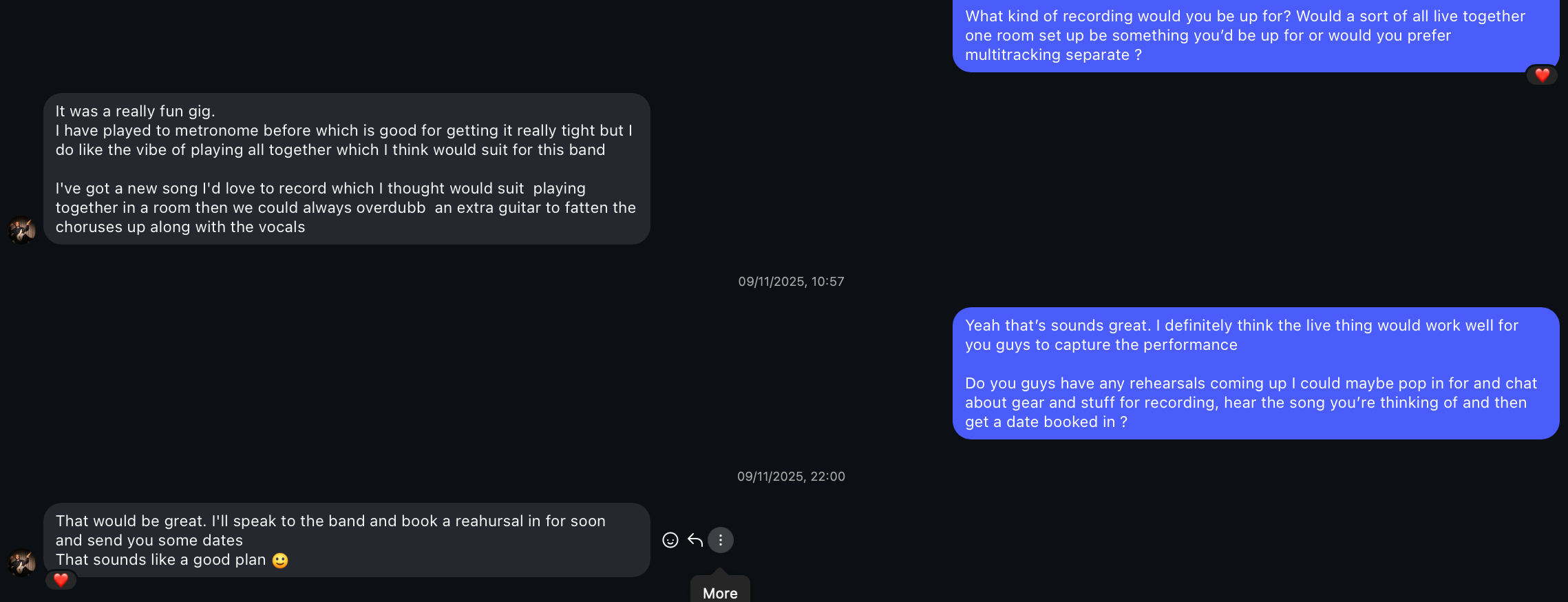
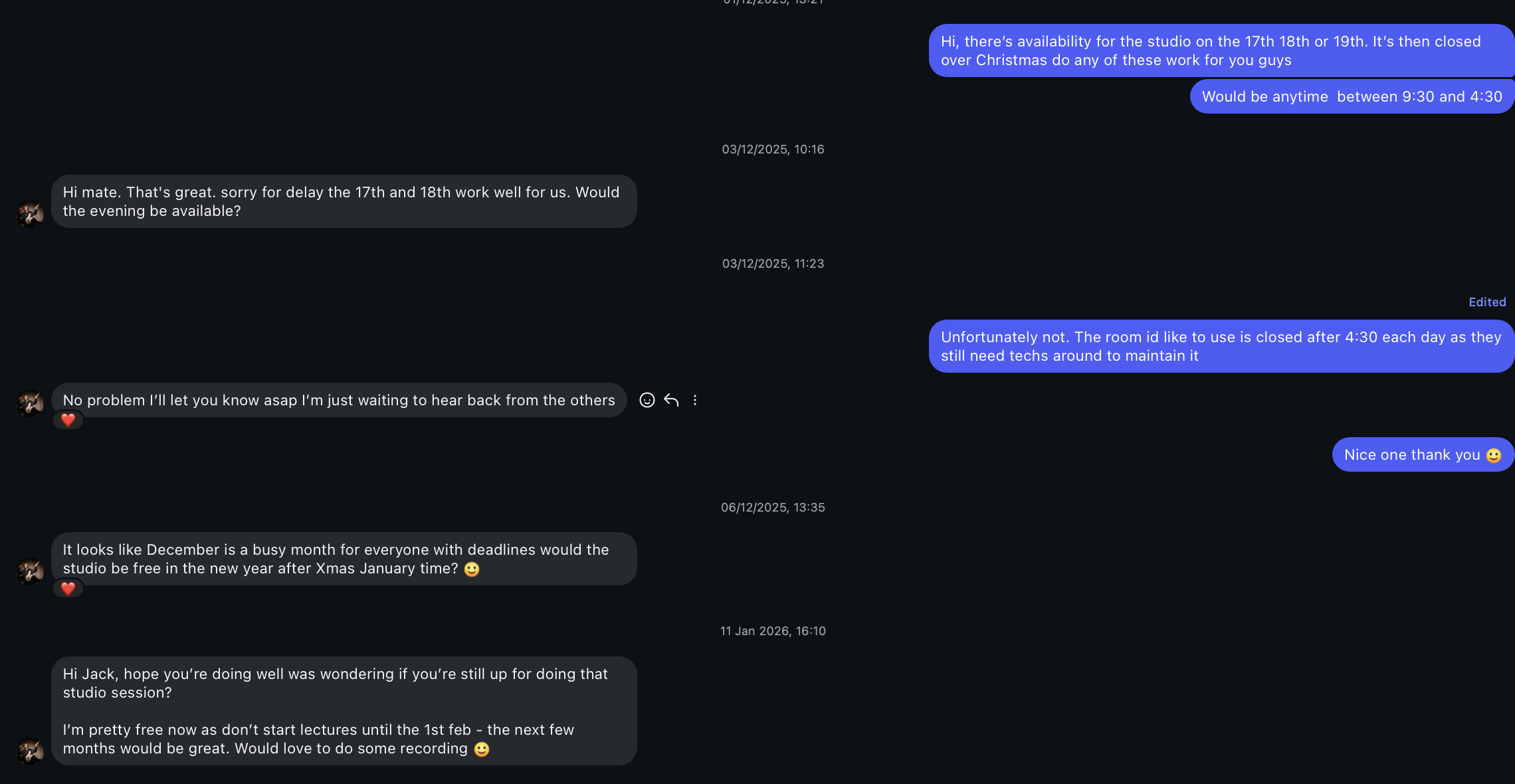
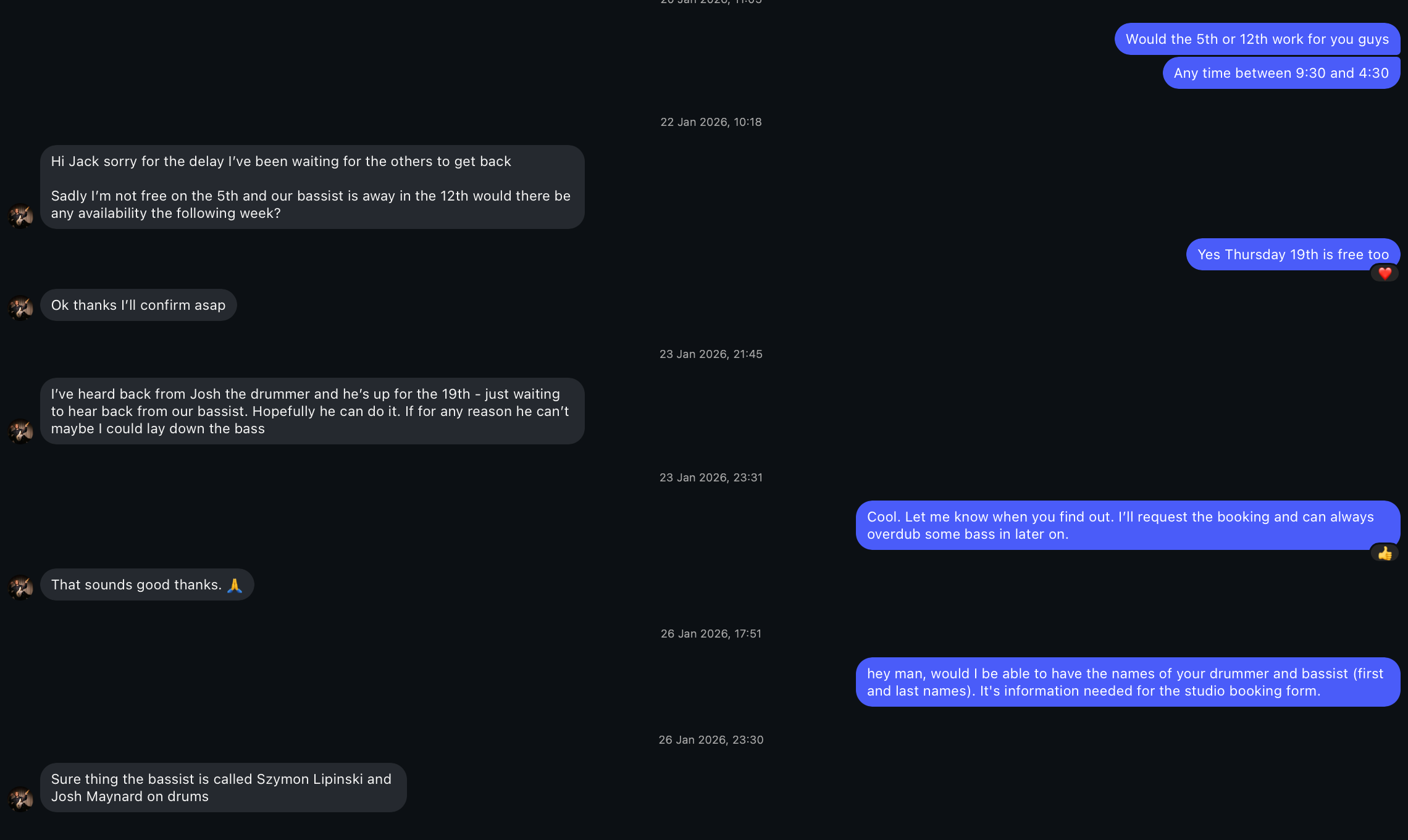
I decided to approach Tarn after his band supported a band I am the drummer in, Greensmith, at a gig. I really liked how tight the band played together and they seemed to have their individual styles and overall sound all figured out. As I was interested in doing a live-style recording set up in The Hive, I felt a tight, three-piece band like Tarn’s, with a relatively simple set up, would be perfect. I spoke to Tarn after the gig and he seemed really interested in doing some recording, especially with the live approach. I then followed up the next day with an Instagram message to confirm and get a session booked. This was near Christmas 2025 and the university studios had closed for the holiday, so we had to arrange a date in the new year. We settled on February, as that fitted around everyone's semester one deadlines. I booked two sessions in the end: one 6-hour day to get the guitars, drums, and bass all tracked live together in one room. The second 3-hour session was to overdub vocals, as the bleed from the whole band playing in one room would be too much to clearly record the vocals.
I didn’t get the opportunity to meet with the band in a rehearsal before recording, so Tarn sent a video of the song so I knew what to expect. After chatting over Instagram a lot, the influences of his music were also clear - ZZ Top, Black Crowes, Led Zeppelin and Jimi Hendrix.
(Kick and snare SSL EQ)
Recording Process
Drums
For a band with influences like Jimi Hendrix, Josh (the drummer) had a very unexpected set up. He came to the session with a double kick drum pedal, fx cymbals, bells and additional concert toms. A lot of stuff that needed to be captured in the recording!
I still kept the set up fairly simple to try to stay true to the band's influences. The microphone set up included:
Kick In - AKG D12
Kick Out - Soyuz 023
Snare Top - SM57
Snare Bottom - SM57
Tom 1 - MD421
Tom 2 - MD421
OH Stereo Pair - AKG C414
Mono Room - Coles 4038
Concert Tom 1 and 2 - MD421 (I chose to mic these from the open bottom end)
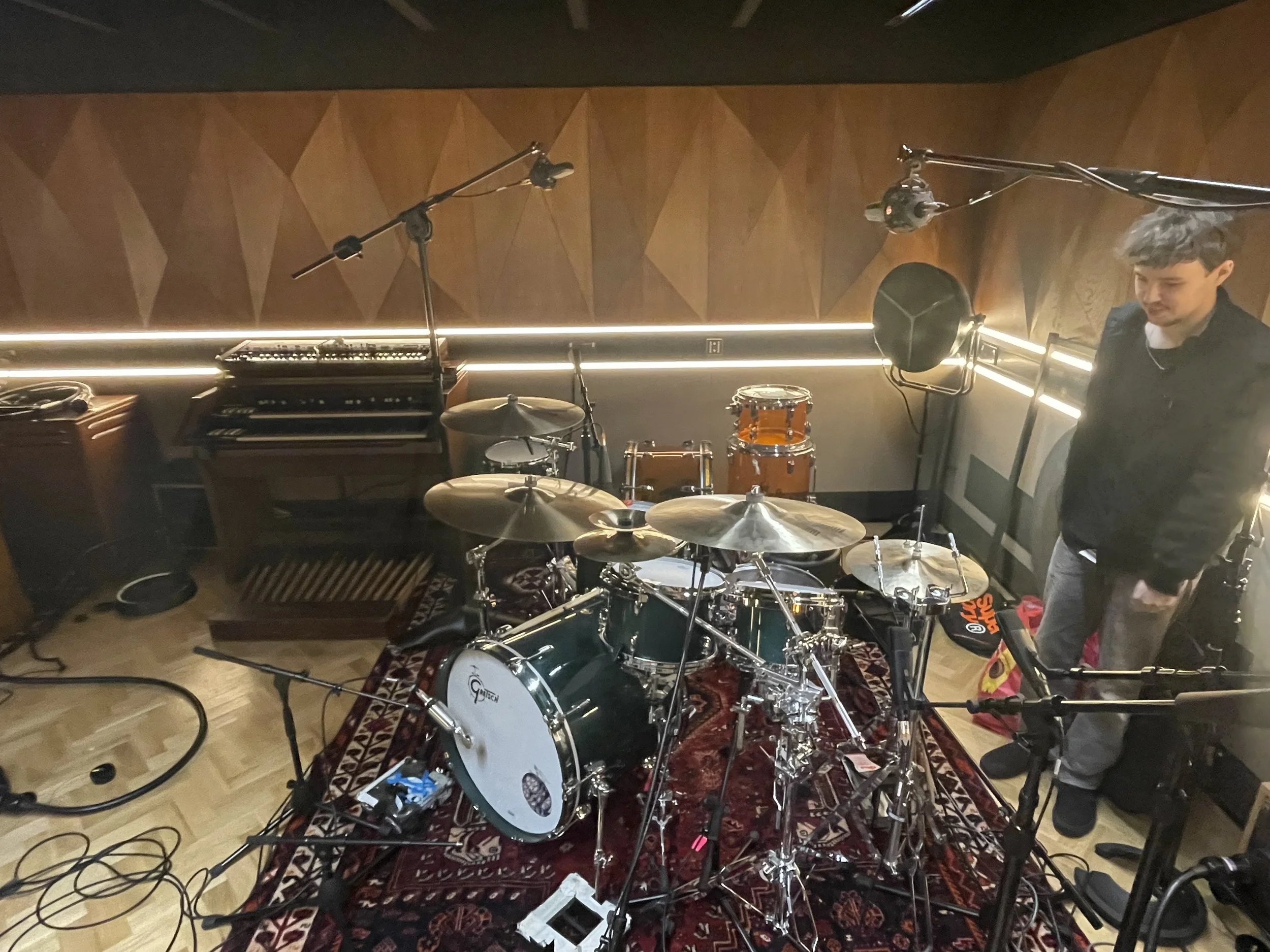
(Drum recording setup)
We chose to use the Gretsch kit as the coated drum heads would provide warmer tones. Josh chose to use his own snare, which was metal and tuned really high. This sounded great in the room, however, when I isolated the snare close mics it was apparent that the snare wasn't the right choice. The tight tuning was choking the resonance of the drum and removing a lot of body, while all the other drums resonated well and had a nice warm feel. To me, the snare sounded separated from the rest of the kit. If I record with Tarn again I will suggest trying other available drum equipment that might suit the songs better than the drummer's own equipment.
Josh also tended to overplay, in my opinion, with a lot of long and busy drum fills. These sounded good in some sections, like coming out of the intro with a ‘Hawaii Five-O’ style roll on the concert toms. However, the frequent fills felt too much. After a few takes, I brought this up and the band did agree. However, even with a reduction in the fills, I personally felt the drums were still overplayed and didn't serve the song as much as they could have done.
Guitar
Tarn chose to use a Mesa Boogie Dual Rectifier Maverick. This amp has really smooth saturation and gain, and an overall vintage sound that is perfect for Blues and Rock style playing. I chose to keep the mic set up simple and just used one Beyerdynamic M160 ribbon microphone. The ribbon mic helped battle harsh high-end frequencies and provided a nice smooth, warm capture of the amp. I positioned the amp and mic in the room to utilise the microphone null and get the most rejection of the drums.
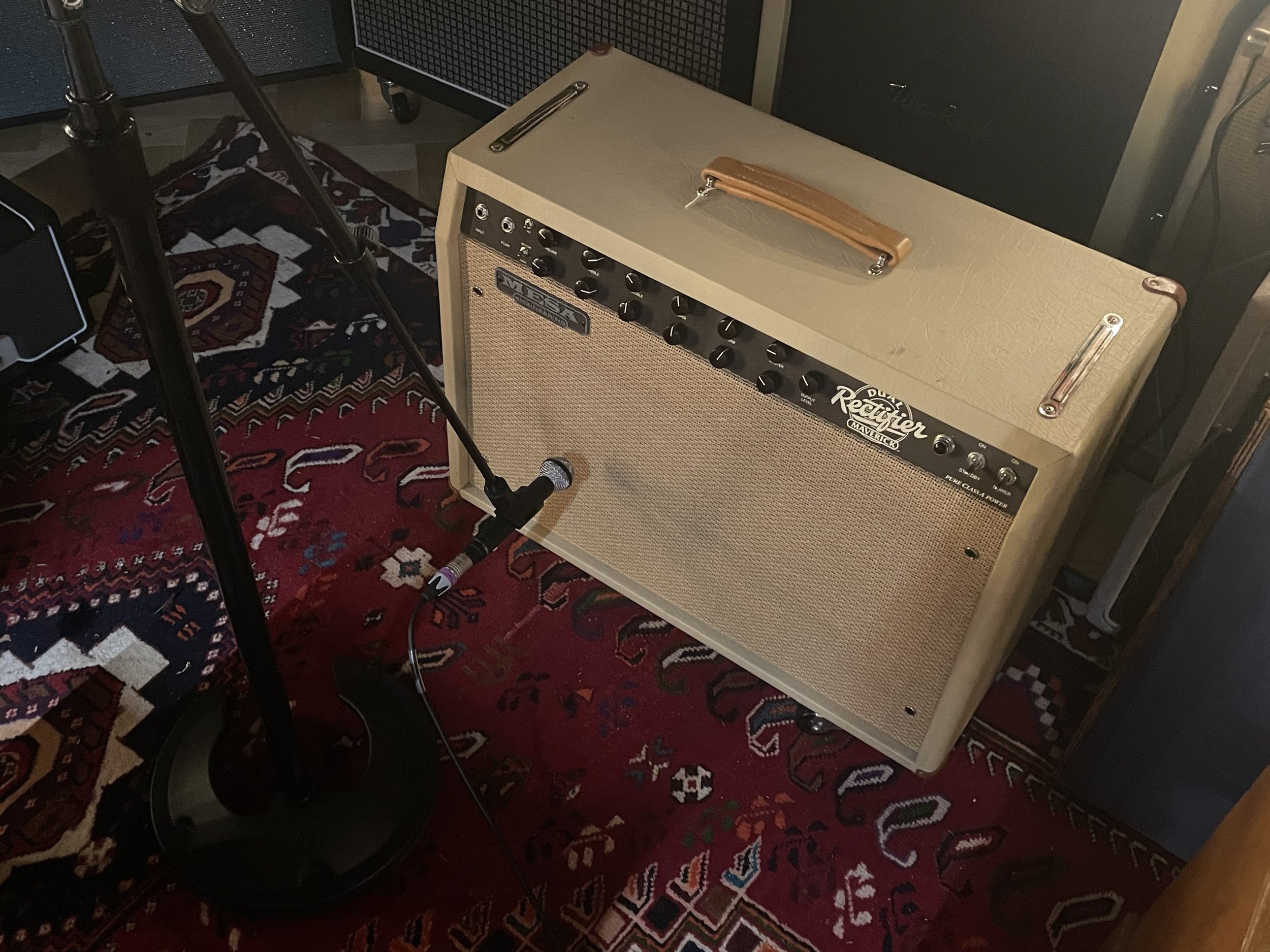
(Guitar recording setup)
We individually overdubbed the solo and additional lead parts once the band had a take they were happy with. I also tried placing the microphone further back from the amp than I usually would, in order to capture a more whole and natural image of the amp for these parts.
Bass
Unfortunately, on the day of the recording the bassist was late and not able to attend for more than an hour. This wasn't very useful as once we had set up he then had to go. This was a shame as it meant the second session dedicated to vocals would now also be needed for bass. However, having no bass playing in the room during the guitar and drums recording meant more separation for the final mix. During the second session, Tarn arrived with a new bassist! We set up the Ampeg SVT stack. I used a DI to capture a clean bass signal and low-end, and then used an MD421 on the cab. I did try an Austrian Audio OCC818 and an AKG D12 on the cab, but felt the MD421 provided a tighter sound. The new bassist had no pedals, so we achieved a bit of drive by just using the amp.
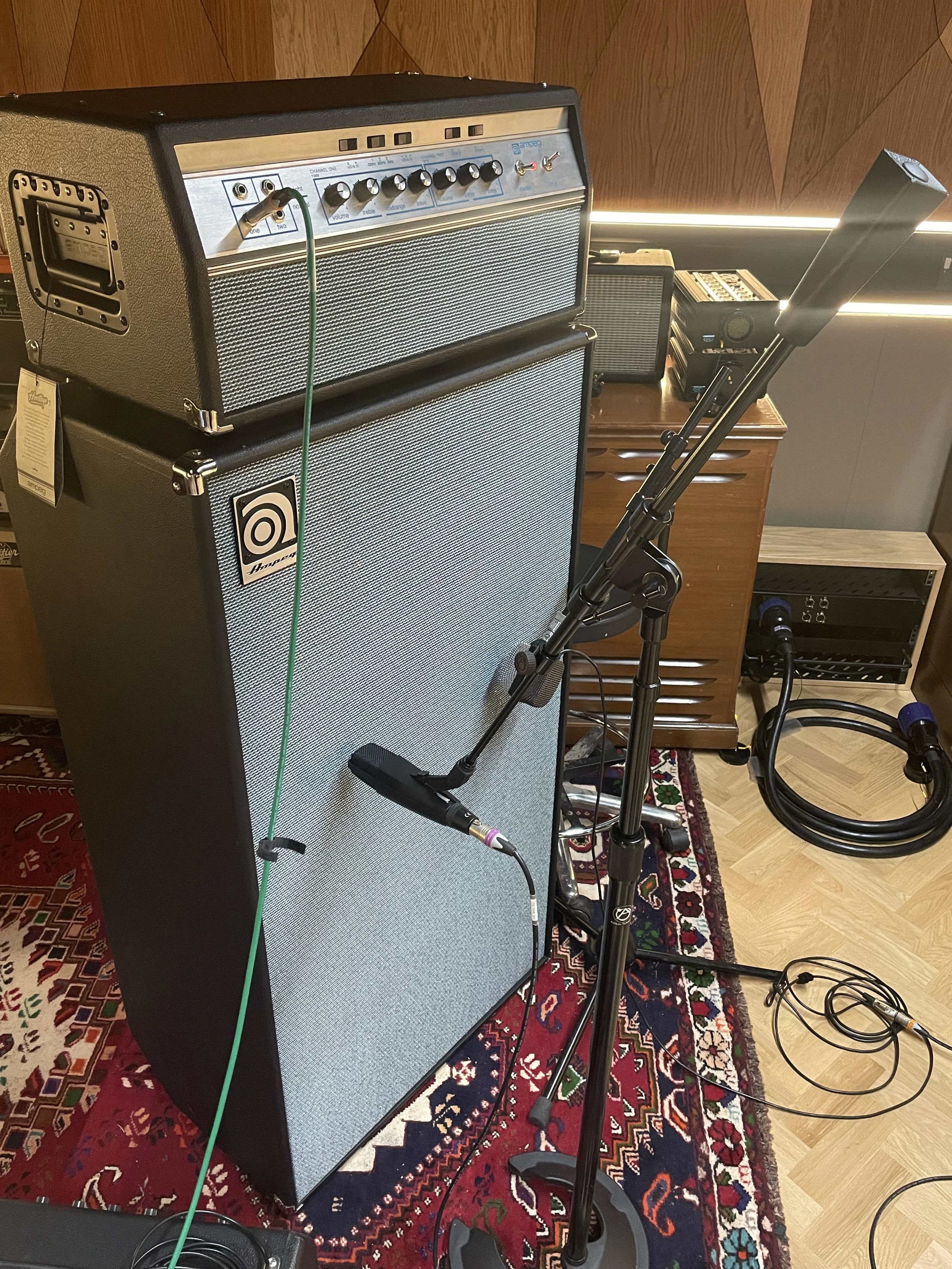
(Bass recording setup)
Vocals
During the live tracking session I did provide Tarn with a vocal mic, but this was solely to help him guide the band when playing the song together. For the overdub session I chose a Flea 47 Tube Mic. This mic captured a very natural recording of Tarn’s voice, and it sounded ‘mixed-ready' straight away.
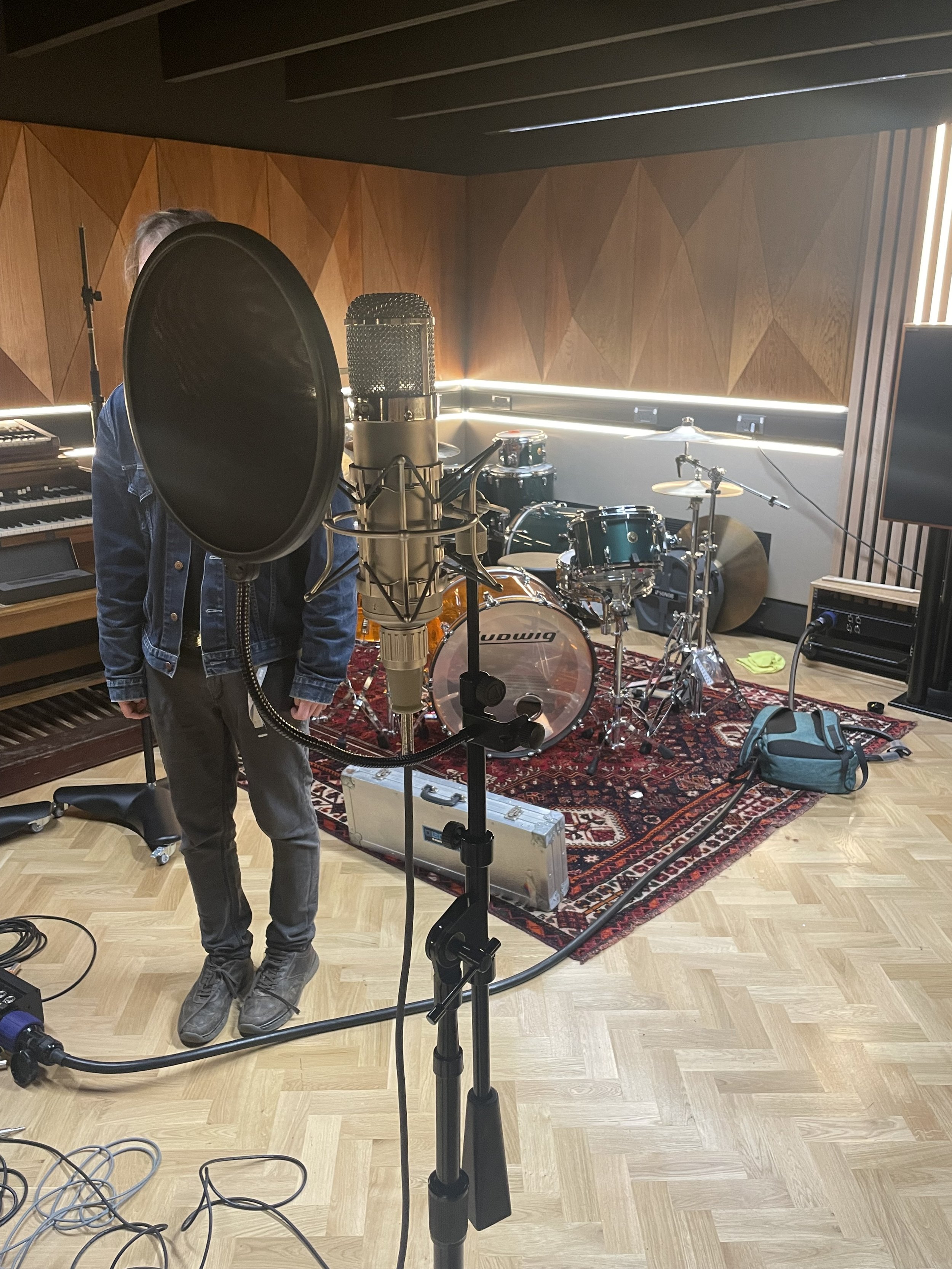
(Vocal recording setup)
Mixing Process
I went into this project with the intention of doing very little mixing in Logic. I wanted to try and use The Hive’s outboard gear to capture the best sound possible at source when recording. That way, I would be committed to any EQ, compression, or other effects I used. This seemed an appropriate approach for Tarn’s band, especially as his influences were from an era of no plug-ins or DAW’s. Initially, I tried to use the patchbay and mix during the band's soundcheck. However, there is no separation in The Hive, with the console, monitors and live room all in one. Even with headphones on, I could not monitor the recording well enough to properly mix the band using the outboard gear.
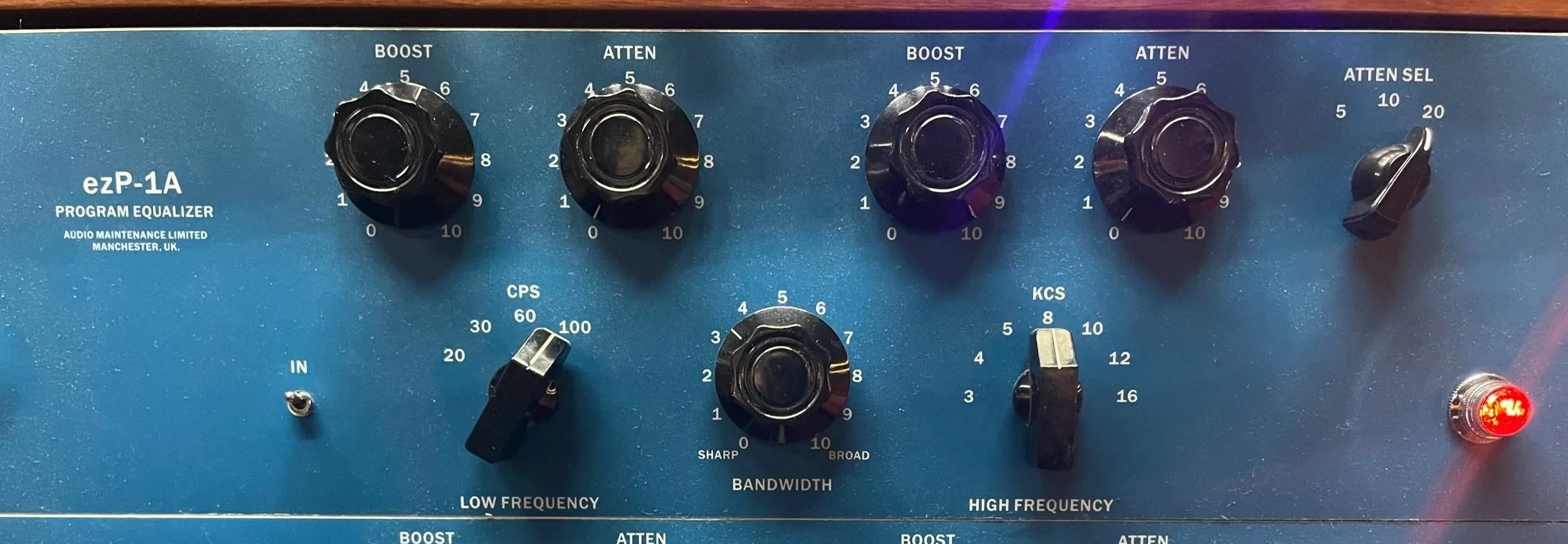
(Pultec EQ)
(LA-2A vocal compression)
(Initial scheduling discussions)
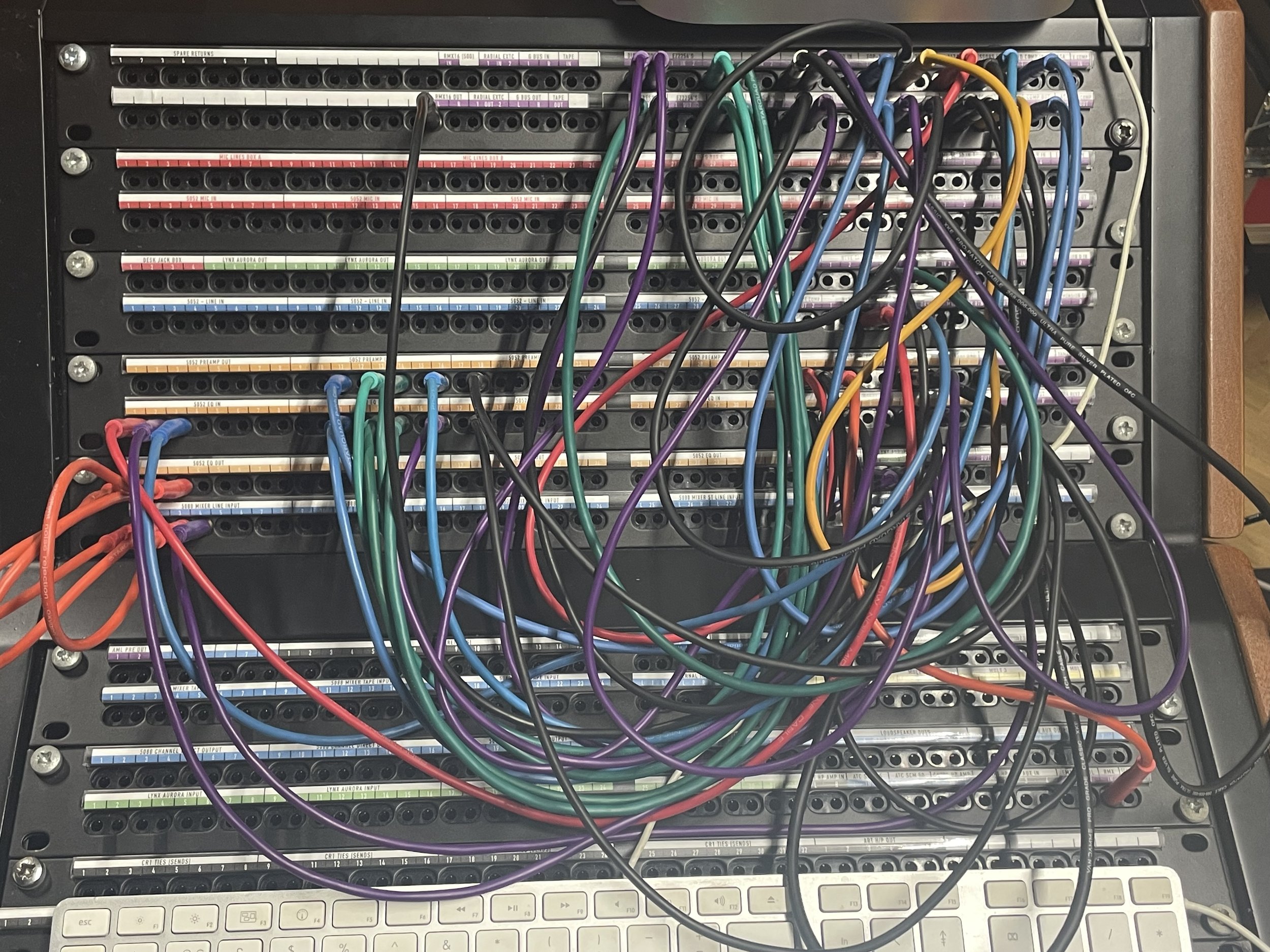
(Patchbay for analogue mix)
My solution to this was to get a rough take of the song, and then tell everyone to go for lunch. I then sent each microphone track in Logic out onto an individual channel on the mixing console and mixed using the Neve console and other outboard equipment. Once happy with my mix and console settings, I could be confident in what the outboard gear was doing when I recorded further takes of the band.
For each channel I used the Neve high-pass filters to cut unnecessary low-end and its EQ’s to cut bad sounding frequencies. I also used the EQ ‘Silk’ circuit to add in harmonic colouration and saturation. The red setting worked best for drums, and the blue for everything else.
Drums
As there was a limited amount of outboard gear available, I needed to be efficient with my channels and selective with what gear was used. I did this by using the console group buses. All the kick mic channels were sent to one, and the snare channels to another. This meant that I could compress and EQ them collectively as groups. I used distressors initially, and then SSL EQ to boost specifically identified frequencies. When it came to recording these groups back into Logic I had to create new inputs that matched with the groups on the desk.
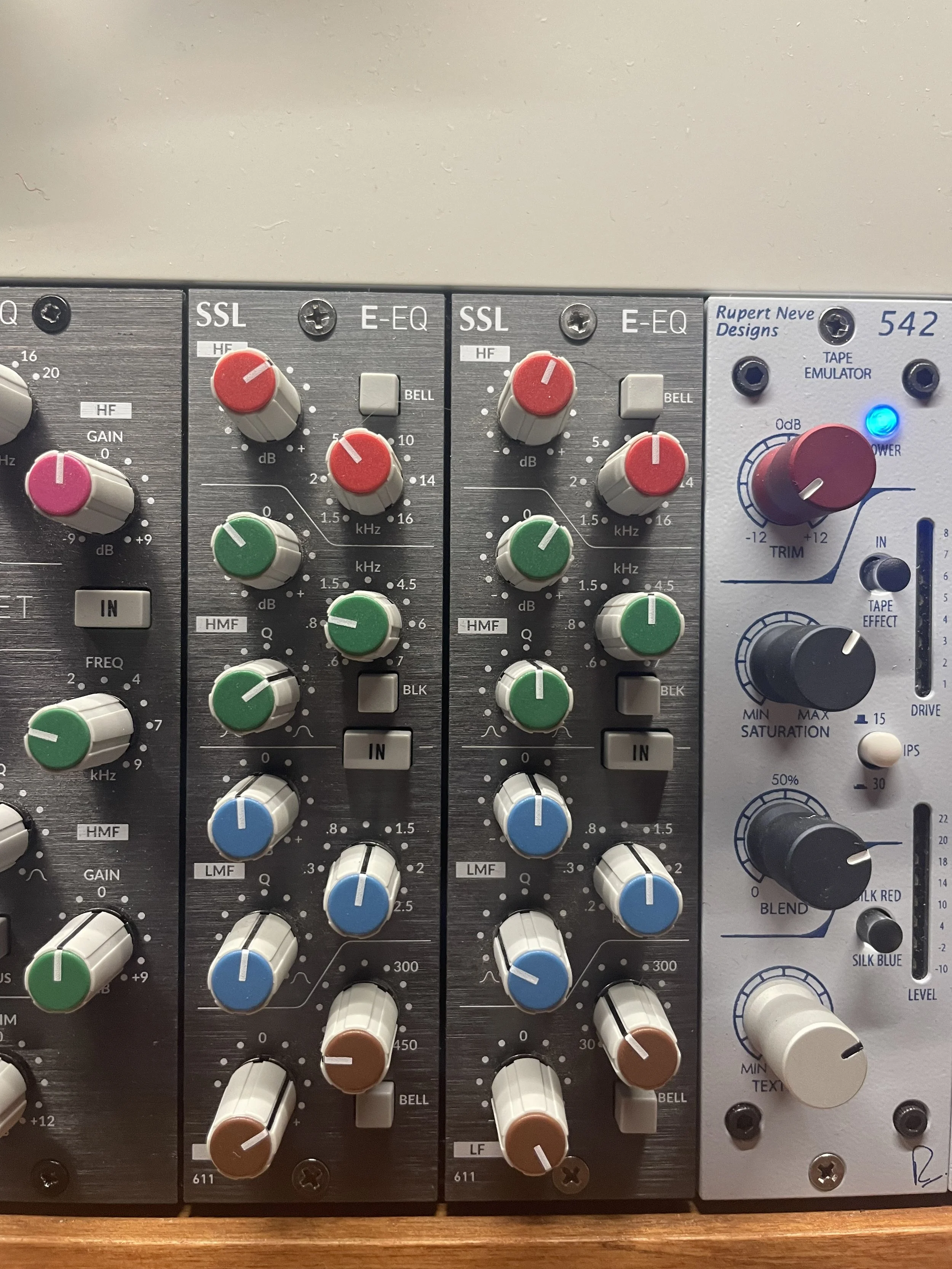
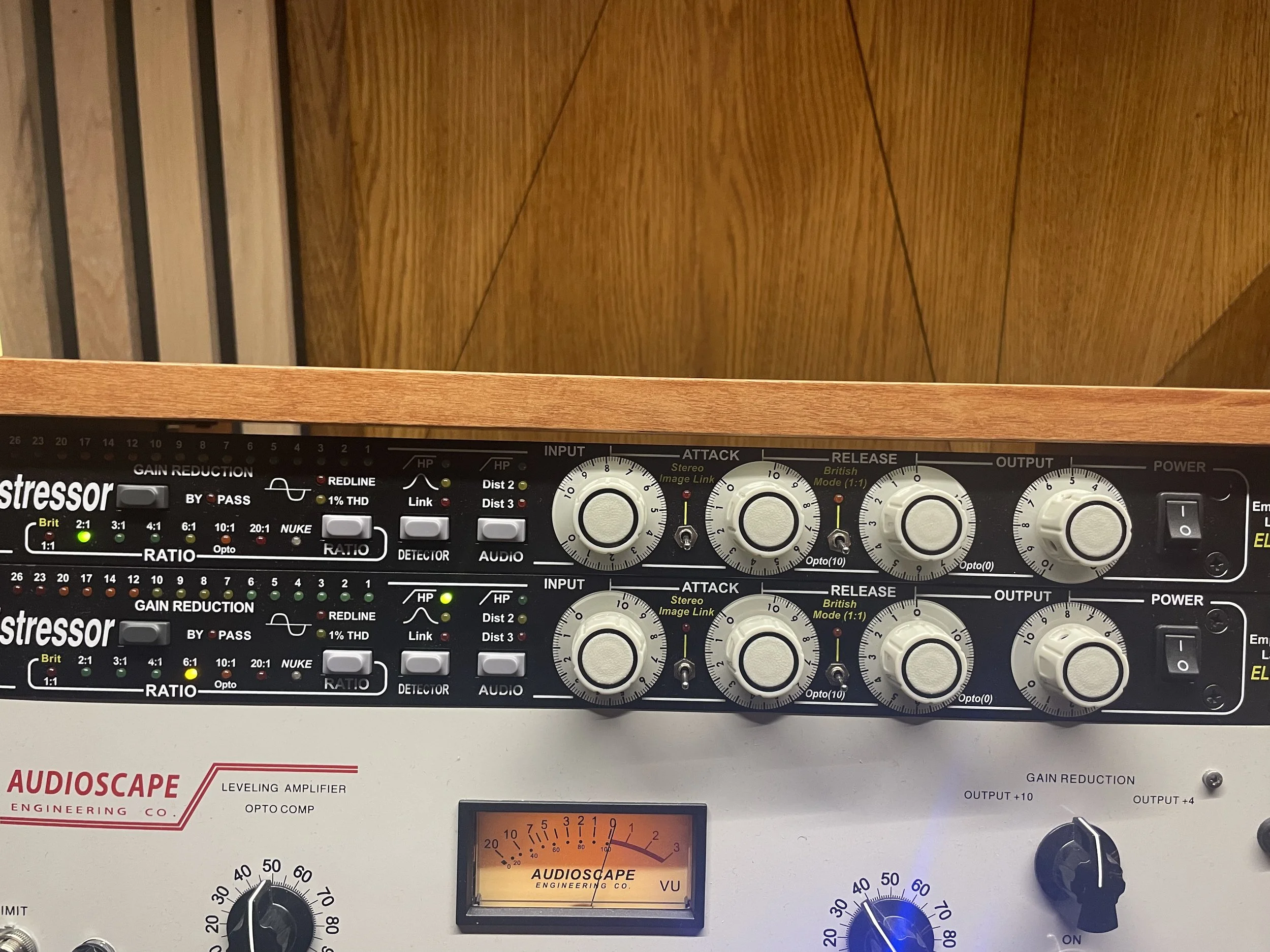
(Kick and snare Distressor compressor )
The room mic was compressed using an 1176. I had the ‘release’ as fast as possible and the ‘attack’ set at around 12 o’clock, to bring out more life in the room.
All of the drum channels were also sent to a group for parallel compression, again using the 1176. I tried my best to match the setting on the left and right channels to ensure a consistent stereo image. I then recorded this group as a new channel within Logic in order to blend the wet and dry drum signals in post. In the end, I wasn't happy with the result and did the process again with plugins. This gave me more control over how much of each microphone was sent to the parallel compression bus.
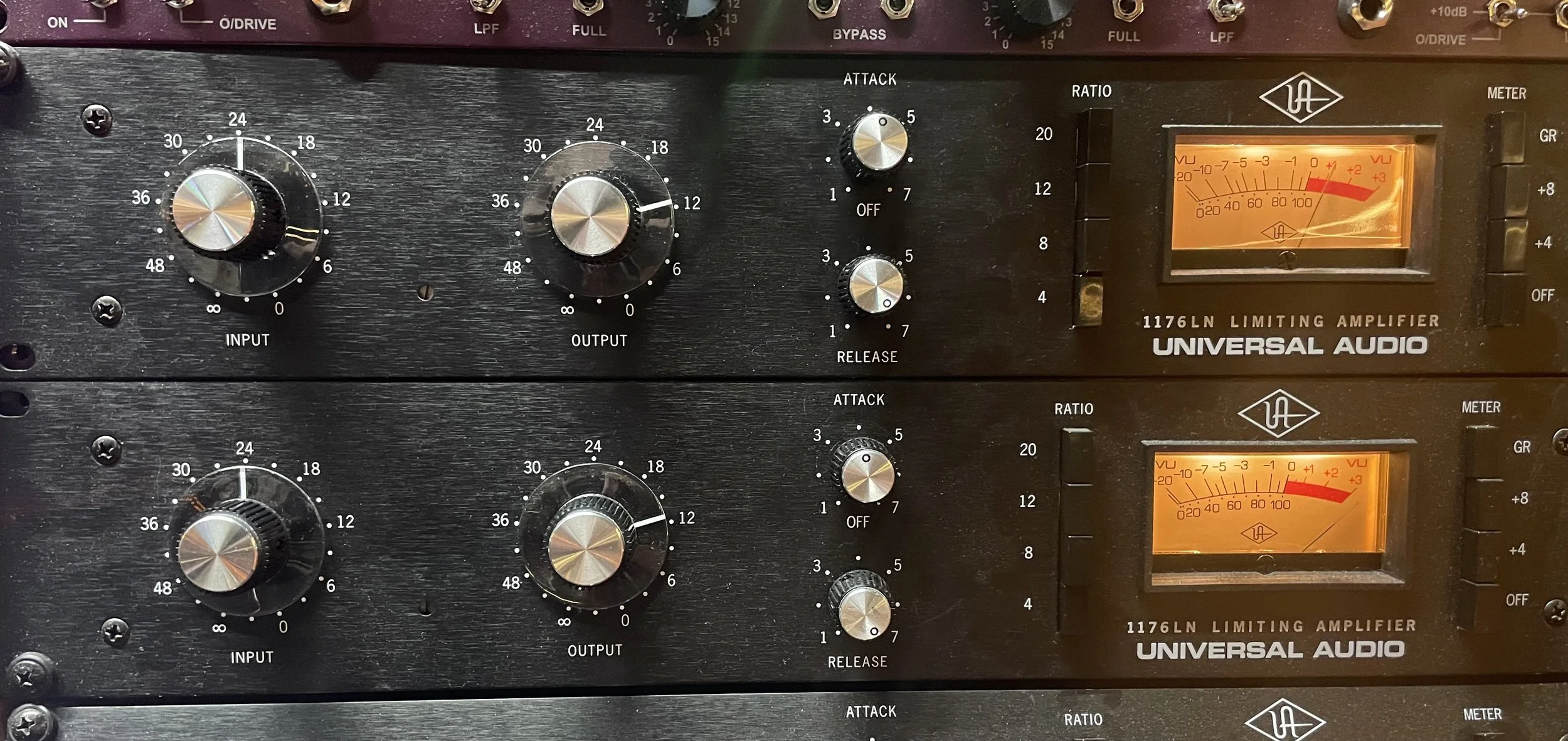
(1176 parallel compression)
Due to the snare not being quite right for the sound of the band, I did end up using a snare sample, in post, to replace the snare top mic. This felt wrong and I would have preferred to have captured it at source, but it was an easier option to re-recording the entire song and negotiating with Josh and his drum choice.
Guitar
Not much mixing was required for the guitar. A few broad EQ moves on the Neve channel strips, to remove muddy frequencies around 100-200Hz and harsh frequencies around 3kHz. I then used a Neve 542 Tape Emulator to saturate the guitar more and smooth the sound. I also felt that tape would give it a more 60s to 70s sound. An LA-2A compressor was then used, just enough to even out the dynamics of the guitar.
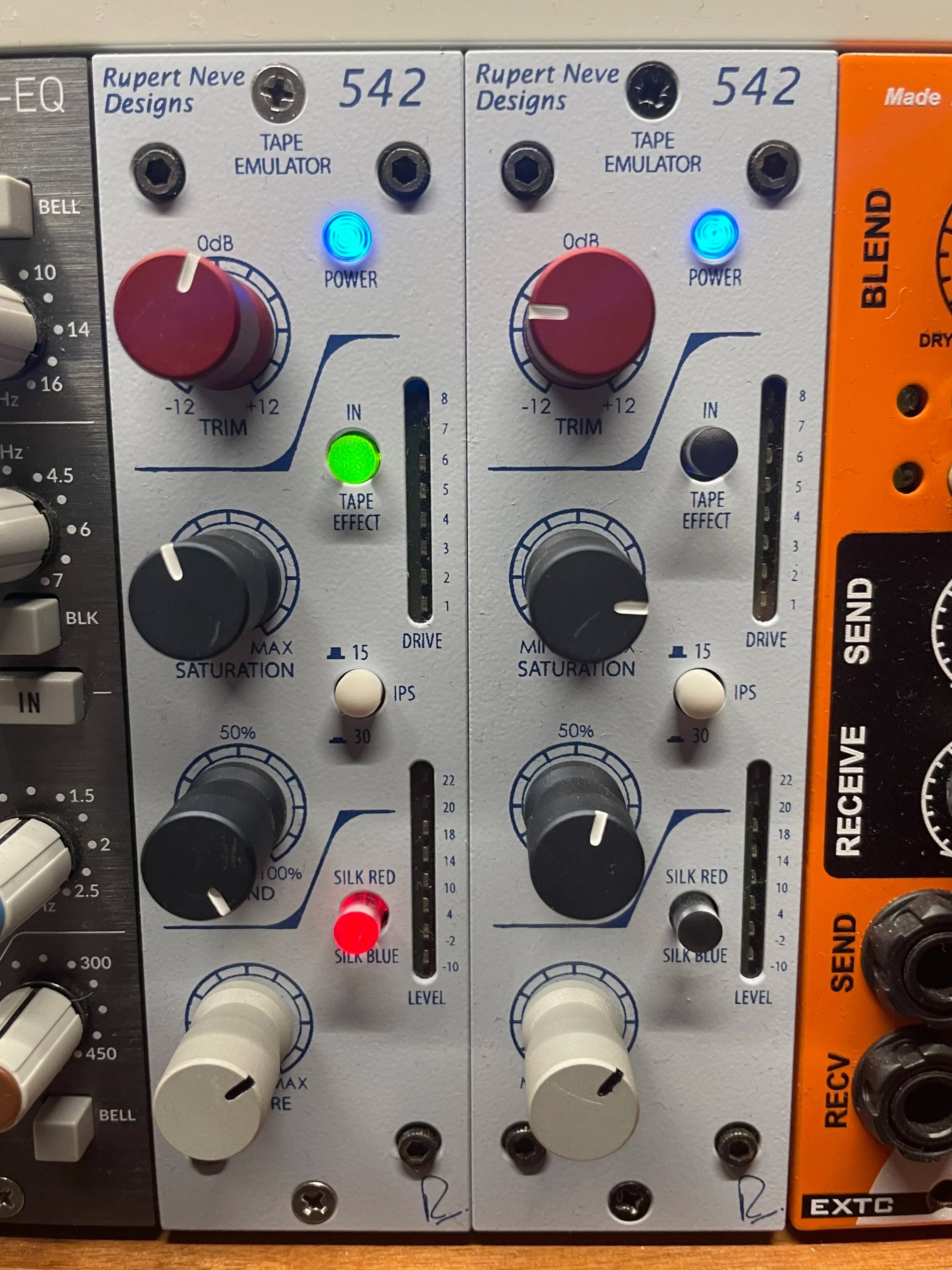
(Neve 542 tape emulation)
Bass
I grouped the DI and MD421 microphone together, with a low-pass filter on the DI. I compressed with the D-Comp Limiter, and then boosted the lows with a Pultec EQ.
In post, I used Fabfilter Pro-Q3 to surgically reduce muddier frequencies. Finally, also in post, I added a small amount of distortion using Soundtoys Devil-Loc and boosted the mid-range to allow the bass to cut through more in the mix.
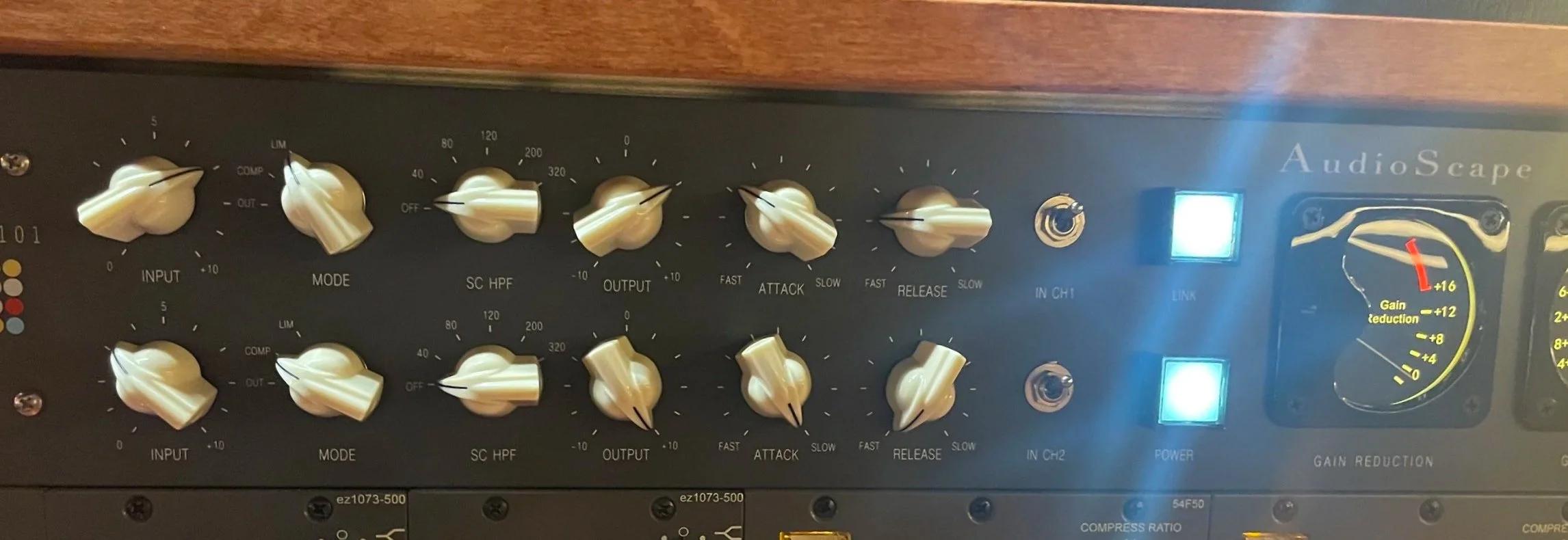
(D-Comp limiter)
Vocals
To start, I used a high-pass filter up to around 100Hz and then reduced further at 200Hz using the Neve channel EQ. I then sent the vocal to a Neve 542 Tape Emulator and saturated it heavily.
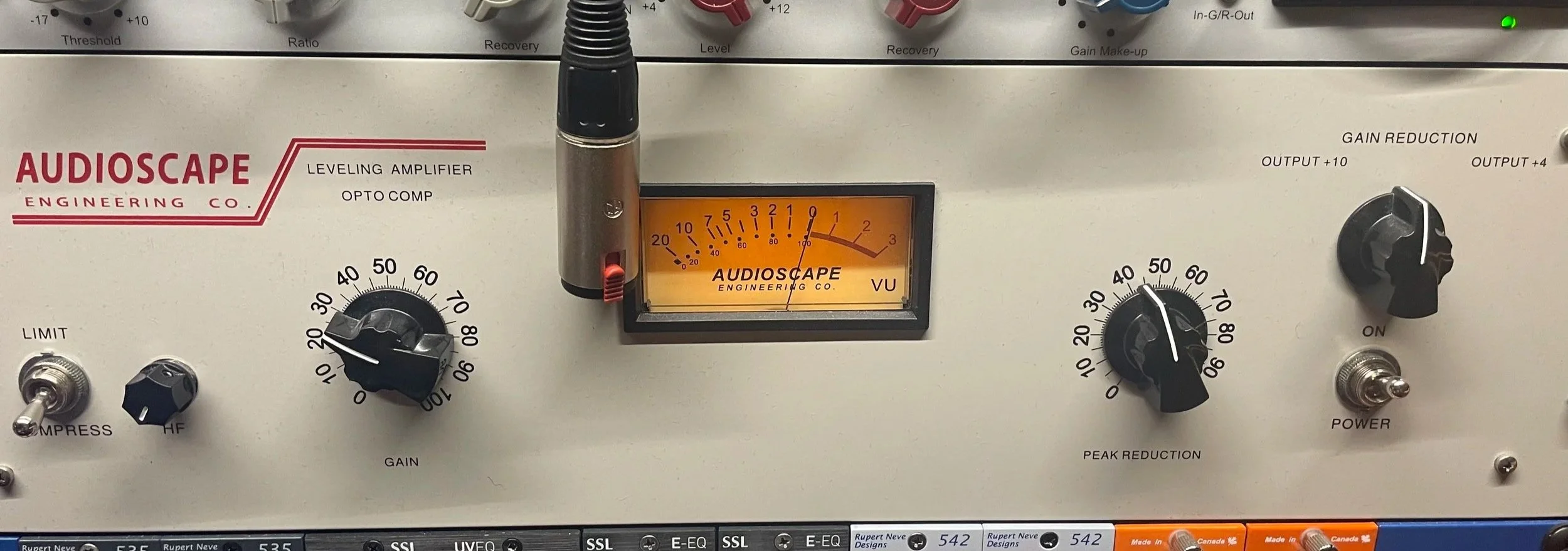
For compression, I first used the 1176 with the ‘attack’ and ‘release’ set around 3 o’clock and a ratio of 4:1. I aimed for -3dB of gain reduction. This compressor is very fast and would do most of the work in leveling the largest peaks in dynamics of the performance. I then used the slower LA-2A to further glue the vocal together, but keeping its natural sound.
In post, I added a slap back style delay, using Soundtoys EchoBoy.
Critical Reflection
Organising this session was fairly simple and, with only two sessions booked close together, it was easy to stay on schedule. The ‘technical’ set up was straightforward. I arranged for the band to arrive an hour after me so that I could get everything ready to go and not keep them hanging around doing nothing. However, with a lot of equipment, setting up took longer than expected on my own. The intention was good, but a lesson learned.
I didn't play much of a producer role in this recording. While I had opinions on the drum parts, I didn't feel it was my place to input too much. Producing wasn't really what this project was about and it wasn't a discussion we had had before the sessions.
I wasn't yet fully familiar with the space's headphone monitoring system. Providing the band with good headphone mixes was initially tricky, and slowed down the process. I have more experience in The Hive now, and it is no longer an issue. Despite struggling to monitor the recording well, I was pleased that I was able to find a solution. It was still hard to judge and make adjustments without room separation though. The primary aim of these sessions was to become more comfortable using The Hive, understand its and my limitations, and I feel I achieved that. It became less intimidating after the first session and since then, with other projects, I have found I am able to think less about what to do technically in The Hive, and focus more on the creative side of recording.
Overall, I feel that I was able to capture the energy and performance of the band well with the live recording approach, and it reflected on the influences Tarn gave me. I was pleased with the result.